

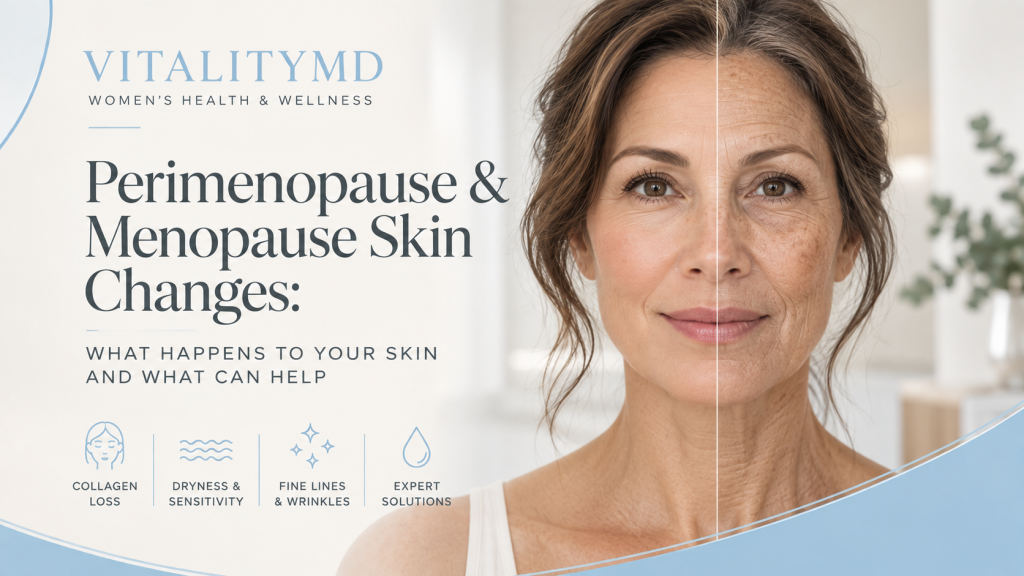
If your skin suddenly looks different during perimenopause or menopause—even though you haven’t changed your skincare routine—you aren’t imagining it. Hormonal changes can affect collagen, hydration, elasticity, facial volume and muscle strength, which means your skin and face may need a different approach as you move through midlife.
Dr. Shari Caplan, physician and women’s health expert at VitalityMD, believes that managing these changes requires more than simply adding another product to your bathroom shelf.
Want to hear Dr. Caplan explain it herself?
In this video, Dr. Caplan breaks down what happens to your skin during perimenopause and menopause, why your old skincare routine may stop working, how hormones can influence collagen and facial structure, and the treatments and lifestyle strategies she uses herself to support healthy-looking skin as she ages.
Why Does Your Skin Change During Perimenopause and Menopause?
One of the biggest reasons skin changes during perimenopause and menopause is the shift in hormones.
According to Dr. Caplan, hormones have a significant impact on skin quality and collagen. She notes that during the first five years of menopause, women can lose approximately 30% of their collagen.
As hormones change, you may begin to notice:
- Drier or less hydrated skin
- Reduced skin radiance
- Changes in skin texture
- Loss of firmness and elasticity
- Fine lines becoming more noticeable
- Changes in facial volume
- A less defined jawline
- Increased laxity around the face and neck
These changes aren’t simply about the skin itself. The underlying structures that support the face also change with age and hormonal shifts.
Facial fat—which provides important structural support—can decrease and shift downward, while facial muscles can weaken and decrease in size. The result can be a gradual change in facial shape, including more noticeable jowling.
This is one reason why the skincare routine that worked in your 20s and 30s may not give you the same results in your 50s and 60s.
Does Menopause Cause Collagen Loss?
Yes, menopause is associated with significant changes in collagen and skin structure.
Collagen loss can be particularly noticeable in the early years following menopause. Women can lose approximately 30% of their collagen during the first five years of menopause.
What Is the Best Skincare for Perimenopause and Menopause?
There isn’t one universal “best” skincare routine for every woman in perimenopause or menopause.
Instead, Dr. Caplan recommends looking at skincare as one component of a larger strategy. A good menopausal skincare approach may include:
1. A Consistent Skincare Routine
Skincare remains important. Products can help support and protect the skin, and Dr. Caplan emphasizes the importance of maintaining a good skincare routine and using sun protection.
However, topical skincare has limitations. Simply putting something on the surface of your skin isn’t necessarily going to address all of the deeper changes occurring during perimenopause and menopause.
2. Sun Protection
Sun protection is essential for preserving the skin you already have. Daily UV protection can help protect against the cumulative effects of sun exposure and premature skin aging.
3. Hydration
Hormonal changes can affect the way skin looks and feels. Supporting hydration from both inside and outside the body is integral to maintaining healthy-looking skin.
4. Nutrition
Your skin doesn’t exist independently from the rest of your body.
Dr. Caplan emphasizes the importance of proper nutrition and replacing deficient nutrients. She also discusses vitamin C and other nutrients in the context of supporting collagen production and overall body performance.
5. Hormone Management
For appropriate patients, hormone management may be an important part of a comprehensive menopause plan.
Hormone replacement isn’t only about symptoms such as hot flashes, night sweats and mood changes. Hormones also play a role in skin quality and how women age.
Hormone therapy is not appropriate for everyone and should always be discussed with a qualified healthcare professional who can evaluate your individual health history, symptoms, risks and goals.
Can Collagen Supplements Help Menopausal Skin?
Collagen supplements are extremely popular—but Dr. Caplan doesn’t consider them a complete solution. Nutrition also matters. Having the nutrients your body needs to support collagen production, including vitamin C, and looking at whether nutritional deficiencies should be addressed.
A supplement may be one component of a broader strategy, but healthy aging involves much more than one product or pill.
Can EMFACE Help With Menopausal Skin Changes?
EMFACE is one of the technologies we use frequently at VitalityMD to address skin changes in perimenopause and menopause.
EMFACE can help rebuild facial muscles while also tightening collagen and elastin. This is particularly relevant when considering menopausal facial changes because facial aging isn’t only a skin problem.
As hormonal changes occur, women can experience changes in:
- Collagen
- Facial fat
- Skin elasticity
- Hydration
- Muscle strength
- Facial structure
That’s why our approach looks beyond the surface of the skin.
What Does Dr. Caplan Do to Maintain Great Skin? This may be the question women are most curious about! Her answer to maintaining great skin and aging well?
A little bit of everything.
Her personal approach includes:
- Eating well
- Exercising
- Hydrating her skin from the inside and outside
- Using targeted skincare
- Taking vitamins and addressing nutritional needs
- Hormone therapy
- EMFACE to work on facial muscles and the skin beneath the neck
- Exion for improved skin quality and hydration
- Radiofrequency microneedling
- CO2Lift PRO
Her approach is about supporting the body, skin, hormones and underlying structures together rather than expecting a single cream, supplement or aesthetic treatment to do all the work.
Why Your 20s Skincare Routine May Not Work in Your 50s and 60s
Your skincare protocol needs to evolve as your body changes.
The routine that worked beautifully in your 20s or 30s may not address the changes you experience during perimenopause, menopause and post-menopause.
That’s because you’re no longer dealing with exactly the same skin—and you’re not dealing with exactly the same hormonal environment.
Menopause skincare isn’t simply about finding stronger products. It’s about understanding what has changed and adjusting your approach accordingly.
For some women, that may mean changing their skincare routine. For others, it may mean addressing nutrition, hormones, hydration, collagen, facial muscle or skin laxity—or some combination of these.
—
FAQs About Menopause and Skin
Why does my skin look different during perimenopause
Hormonal fluctuations during perimenopause can affect collagen, hydration, elasticity and other aspects of skin quality. Changes can also occur in facial fat and muscle, which may alter facial structure and contribute to changes such as jowling.
How does menopause affect collagen?
Menopause is associated with significant collagen loss. Women can lose approximately 30% of their collagen during the first five years of menopause.
What happens to your face during menopause?
Menopausal changes can affect more than the skin. Facial fat can decrease and shift, facial muscles can weaken, and collagen and elastin can change. Together, these changes can contribute to reduced firmness, changes in facial volume and increased jowling.
Can hormone replacement improve skin during menopause?
Hormonal management may also have an impact on skin quality. Whether hormone therapy is appropriate depends on an individual’s health history and should be discussed with a qualified healthcare professional.
What is the best treatment for aging skin after menopause?
There is no single best treatment for every woman. VitalityMD’s approach is based on combination therapy, incorporating skincare, sun protection, nutrition, hormone management and technologies or regenerative treatments based on an individual’s needs and goals.
–
Your Skin Changes. Your Approach Should, Too.
Perimenopause and menopause can change your skin in ways that aren’t always obvious at first. If your usual skincare suddenly isn’t giving you the results it once did, that doesn’t necessarily mean you need a more complicated 12-step routine. It may mean it’s time to look at the bigger picture: Hormones. Nutrition. Hydration. Skincare. Collagen. Muscle. Skin quality.
If you’re experiencing changes in your skin during perimenopause or menopause, book a consultation with the VitalityMD team to discuss your skin, hormone and wellness goals.