
For many women, a lichen sclerosus diagnosis comes with a disheartening prescription: strong topical steroids, used indefinitely, managing symptoms without ever truly healing the underlying tissue. It’s a condition that affects quality of life in profound ways — persistent itching and burning, painful intercourse, vaginal dryness, and a quiet but real impact on intimacy and daily confidence.
At VitalityMD, we’ve never been satisfied with “manage and monitor.” For years, I’ve believed that lichen sclerosus (LS) is an autoimmune-mediated condition that deserves a regenerative response — one that targets the tissue itself, not just the symptoms on the surface. That belief is now backed by peer-reviewed research.
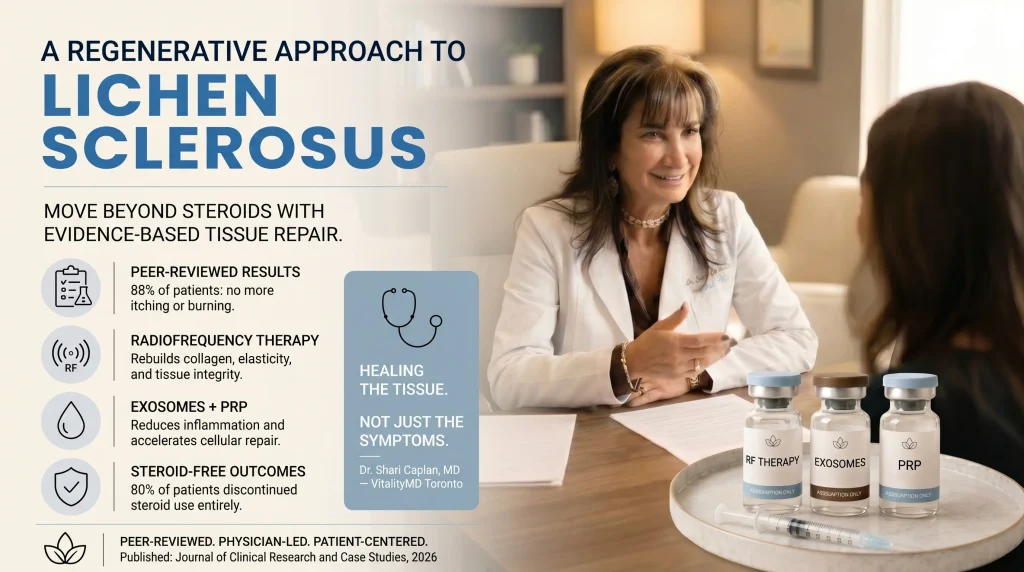
Earlier this year, I co-authored a clinical case series published in the Journal of Clinical Research and Case Studies examining a multimodal regenerative protocol for lichen sclerosus. The results were compelling.Key Clinical Findings — Patient-Reported Outcomes
100%
Reduction in distress related to inability to orgasm
88%
Of patients no longer experienced itching or burning
80%
Were able to discontinue steroid use entirely
75%
Experienced resolution of vaginal dryness
What Is Lichen Sclerosus — and Why Does Standard Treatment Fall Short?
Lichen sclerosus is a chronic inflammatory skin disorder that primarily affects the anogenital area. It can present at any age, though it is most common in perimenopausal and postmenopausal women. Symptoms range from mild itching to severe burning, tearing, and scarring that narrows the vaginal opening and makes intercourse painful or impossible.
The standard treatment — ultra-potent topical corticosteroids like clobetasol — is effective at reducing inflammation, but it does not reverse tissue damage or restore structural integrity. Many patients use steroids for years, and while symptoms may be controlled, the underlying tissue degeneration continues. Sexual dysfunction, loss of sensation, and emotional distress often persist.
“Clobetasol is the standard of care — but there is a better way to heal the tissues instead of just controlling symptoms.”
The Regenerative Protocol: Three Layers of Healing
The approach we studied combines energy-based technology with biologically active treatments to address LS at multiple levels simultaneously. Each component plays a distinct role in the healing process.
- 360° Monopolar Radiofrequency (RF)
Applied intravaginally or to the vulvar surface, monopolar RF generates controlled deep heating that stimulates fibroblasts to produce collagen and elastin — restoring structural integrity, elasticity, and moisture to tissues that have become thin and fragile. It also enhances blood flow to the area, which is essential for tissue oxygenation and healing. - Fractional RF (FRF) Microneedling
This technology creates precisely controlled micro-injuries in the tissue, triggering the body’s natural wound-healing cascade. The result is increased dermal thickness, improved density and firmness, and enhanced elasticity. FRF microneedling is the cornerstone of the protocol and was used for all patients in the study. - Exosomes or Platelet-Rich Plasma (PRP)
Biologically active treatments amplify the regenerative response. Exosomes — extracellular vesicles derived from stem cells — reduce inflammation, improve skin elasticity, and address itching and dryness at a cellular level. PRP, derived from the patient’s own blood, delivers concentrated growth factors that stimulate vascularization and collagen renewal. For some patients, ethical considerations led to the use of PRP as an alternative to exosomes.
Patients received up to three treatment sessions, spaced two weeks apart. The protocol was individualized — the inclusion of intravaginal RF was based on each patient’s clinical presentation and goals, including whether they wished to resume or maintain penetrative intercourse.
What the Results Showed
Ten patients ranging in age from 39 to 88 participated in the case series — nine women and one man. Nine completed all three sessions and at least one follow-up visit. No adverse events were reported at any point during treatment.
Among the patients who completed the Lichen Sclerosus Questionnaire, every single one reported that LS no longer interfered with their daily activities. Beyond that headline result, 60% experienced resolution of active tearing, and 33% saw improvement in vaginal atrophy.
For patients who also completed the Female Sexual Questionnaire, the improvements extended into sexual health: pain during intercourse decreased by 49%, lubrication improved by 44%, sexual arousal increased by 41%, and libido improved by 27%. Stress urinary incontinence severity improved by 58%.
One patient — an 88-year-old woman — demonstrated visible tissue improvement even after a single treatment session. Clinical photographs showed resolution of fissures, reduced inflammation, smoother texture, and improved colour and hydration. Another patient, followed at nine months, reported complete resolution of vaginal atrophy, narrowing of the introitus, and persistent itching — and a fivefold increase in sexual arousal scores.
Why the Full Protocol Matters
One finding worth noting: the patient in the study who received FRF microneedling with exosomes and PRP, but without monopolar RF, reported less pronounced improvements than those who received the complete protocol. While she experienced a 33% reduction in pain during intercourse, there were no significant changes in lubrication, elasticity, or visual appearance at one month.
This contrast points to the importance of the multimodal approach. Monopolar RF delivers deeper, more diffuse heating across a broader tissue volume than FRF microneedling alone, which appears to be essential for more comprehensive regenerative outcomes. The combination of modalities creates a synergistic effect that no single treatment can replicate.
A Shift From Symptom Control to Regenerative Care
This research represents something I am deeply committed to: moving lichen sclerosus care from a model of indefinite symptom suppression toward one of genuine tissue restoration. The goal is not to mask the condition with steroids — it is to rebuild the tissue, restore function, and give patients their quality of life back.
Eight out of ten patients in this study who had been using steroids were able to discontinue them entirely following treatment. For patients who have spent years managing side effects and still struggling with symptoms, that outcome is significant.
This is still early-stage research — a small case series without a control group — and larger controlled studies are warranted. But the patient-reported outcomes are meaningful, and the safety profile across all sessions was excellent. We are committed to continuing this work and refining the protocol.
Frequently Asked Questions
Is there a cure for lichen sclerosus?
There is currently no definitive cure for lichen sclerosus. Standard treatment with topical corticosteroids controls inflammation but does not reverse tissue damage. Regenerative approaches using radiofrequency therapy and biologics such as PRP or exosomes are showing promising results in early clinical studies, with many patients achieving significant symptom relief and tissue improvement.
Can lichen sclerosus be treated without steroids?
In this clinical case series at VitalityMD, 80% of patients who had been using steroids were able to discontinue them after completing a regenerative treatment protocol combining radiofrequency therapy with exosomes or PRP. While steroids remain the standard of care, regenerative options may reduce or eliminate the need for long-term steroid use in appropriate patients.
What is radiofrequency treatment for lichen sclerosus?
Radiofrequency (RF) treatment for lichen sclerosus uses controlled energy to heat tissue and stimulate collagen and elastin production. Monopolar RF can be applied to the vulvar surface or intravaginally, improving elasticity, moisture, and blood flow. Fractional RF microneedling creates micro-injuries that trigger the body’s healing response, increasing dermal thickness and firmness. Both are non-surgical and minimally invasive.
What are exosomes and how do they help lichen sclerosus?
Exosomes are tiny extracellular vesicles derived from stem cells. They carry anti-inflammatory signals and growth-promoting molecules that help reduce inflammation, improve skin elasticity, and alleviate symptoms such as itching and dryness. When applied to affected tissue in combination with energy-based treatments, they amplify the regenerative response and support cellular repair at a deeper level.
How many treatments are needed for lichen sclerosus with this protocol?
In the VitalityMD clinical case series, patients received up to three treatment sessions spaced approximately two weeks apart. One patient achieved notable improvement after just a single session. The protocol is individualized based on each patient’s symptoms, clinical presentation, and treatment goals. See how this protocol is applied in practice.
Does lichen sclerosus affect sexual function?
Yes. Lichen sclerosus frequently impacts sexual health, causing pain during intercourse, reduced lubrication, decreased arousal, and in some cases inability to achieve orgasm. In our case series, patients who completed the Female Sexual Questionnaire reported a 49% reduction in pain during intercourse, 44% improvement in lubrication, and complete resolution of distress related to inability to orgasm following the regenerative protocol.
Can men get lichen sclerosus?
Yes. While lichen sclerosus is far more common in women, men can also be affected, typically on the penile skin. In our case series, one male patient was treated with fractional RF microneedling and exosomes and reported significant improvement at the four-month follow-up, including the ability to discontinue corticosteroid therapy and resolution of penile atrophy, active tears, and itching.
Published Research
Dr. Shari Caplan & Dr. Yalda Nasir. “Regenerative Approach for Lichen Sclerosus: A Case Series Combining Monopolar and Fractional RF Therapy with Biologics.” Journal of Clinical Research and Case Studies. 2026; 4(1): 1–4. DOI: doi.org/10.61440/JCRCS.2026.v4.95
Ready to Explore Your Options?
If you’ve been managing lichen sclerosus with steroids alone and want to learn whether a regenerative approach may be right for you, we invite you to book a private consultation with Dr. Caplan.